Libertas’s illiberal friends
Submitted by David Uwakwe on Monday, 2 March 2009One CommentDoes Libertas really believe what its new right wing friends believe, asks Dave Uwakwe, or is it just desperate for allies?
The recent controversy surrounding Libertas’s efforts to register itself as a European political party in time for the upcoming European elections has brought confusion and clarity in equal measure to our understanding of the organisation as a political entity.
The confusion has resulted from the denial of two of the supposed signatories to their application for EU funds to help finance their campaign. First, Igor Grazin, an Estonian MP denied that he had ever given his signature to any such application shortly followed by Bulgarian MP Mincho Kuminev who also strenuously denies ever signing any documents in relation to Libertas.
Libertas fired back claiming that those individuals were intimidated into rescinding their support by the European Commission. On their website they have posted photo evidence of the signatures in question on the pertinent documents.
The rules concerning the establishment of pan-European political parties stipulate that at least seven signatures from national or European politicians must be obtained in order to access campaign funds. Consequently the €200,000 granted to Libertas will not actually be made available to them until a full investigation has been carried out.
The Libertas chairman Declan Ganley has lashed out at Brussels, accusing the commission and parliament of orchestrating a dirty tricks campaign, indicative of the un-democratic practises that he and his party want to rid Europe of.
Out of this suspicion and uncertainty however some clarity is beginning to emerge as to exactly what kind of values Libertas espouse, apart from their monolithic opposition to the Lisbon Treaty. By looking at the ideologies subscribed to by those who whose signatures remain on the ill-fated application documents we can surmise Libertas’s own ideological outlook.
“A very clear picture is emerging, and one that begs us to look twice at the stated objectives of the Libertas manifesto”
A very clear picture is emerging, and one that begs us to look twice at the stated objectives of the Libertas manifesto, one of which reads; “For Europe to build a true and successful Union, that Union must include and involve you. The conditions must be subject to you. They must respect your identity and culture.”
One of the signatories of the Libertas application is Cyprian Gutowski, regional assembly member for the All-Polish Youth party. Was it respectful of the identity and culture of all Europeans when members of that party were filmed at in the company of neo-Nazi skin heads, listening to Nazi songs and saluting the swastika?
How indeed does Chairman Ganley propose to harmonise the opposition of the All-Polish Youth party to liberalism, tolerance and relativism, as stated in their founding manifesto, with Libertas’ own profession to “stand for tolerance and for the belief that every citizen has rights and limitless potential.”
How does their stated respect for an individual’s rights of culture and identity chime with the values held by the True Finns party, with whom Libertas are in talks about forming a parliamentary alliance? The Finnish State prosecutor is considering whether to press hate crimes charges against one of that party’s councillors, resulting from his daily anti-immigration blog.
Another supporter is Georgios Georgiou, a member of a Greek nationalist party called Laikos Orthodoxos Synagermos which released a statement when the mayor of the island of Tilos presided over a homosexual civil marriage deploring “the cruel reality that we are living in the society of faggots.”
But we need not look as far as Libertas’s colourful friends overseas to uncover apparent double standards between what the party says and what the party does. Libertas consistently calls for “a new, democratic, accountable and open European Union” whilst failing to account for its own sources of funding and finance to the satisfaction of the Oireachtas or the European Commission, a full eight months after the Lisbon referendum was held.
Until all of this is resolved, and Libertas reveal their actual candidates and policies the information that can be gleaned from the murky waters surrounding the organisation point to a series of contradictions; a purportedly centrist party that gladly enlists the support of anti-semites and homophobes, a supposedly Europhile party that has scoured the halls of Brussels for every Eurosceptic and secessionist to fill its ranks with and finally a party calls for accountability from others whilst refusing to disclose its own sources of funding.
This might all be put down to teething troubles or political naivety. Whatever it is, Ganley and co have a little over four months to prove they are not the far right Eurosceptics that they increasingly appear to be
Tuesday, March 10, 2009
Ganley's racist and neo Nazi pals examined by Irish historian


Saturday, February 14, 2009
No Free Lunch:Ganley's Irish Independent hack Bruce Arnold attempts to divert from Libertas' disarray with accusations of smears.
Arnold asks questions in his piece about Ganley's eastern activities. He does not answer them. When he next dines with Mr. Ganley could he please find out the truth behind Ganley's Anglo Adriatic Investment Company and publish that? If Declan Ganley answered questions more forthrightly, then the confusion about his past and his current program would be resolved for once and for all. Arnold does not refer to the personal vendetta that Ganley and Libertas are waging against Minister for European Affairs Dick Roche. Their website host two recent attacks on him from Ganley while Arnold's article is yet another attempt at the same. Ganley is still smarting from being caught out over his claim his nationality was listed as British on his company returns due to a mistake "box filling". Roche pointed out on live radio that they were handwritten.
While Arnold presents Ganley as a victim anyone who watched the Primetime show on Ganley may take a different view. Arnold cannot ignore the contradictions between Ganley's statements and those of other people featured. Especially moving was the old pensioner who had lost his savings in Ganley International's Anglo Adriatic Investment Fund.
Read Arnold's defence of his ally below
Declan Ganley is the victim of a shameful smear campaign
Saturday February 14 2009
'Dick Roche is still looking. He has found nothing'
Declan Ganley was the most successful Irish politician of 2008. He won the Lisbon Treaty referendum, throwing the Government and opposition into chaotic confusion. He did this democratically. This irritated the losers, particularly Dick Roche. As Minister for Europe, Roche was significantly at fault for the defeat. He was well-versed in EU Lisbon Treaty intricacies, so this was inexcusable.
The campaign points made by Ganley throughout 2008 have been consistently ignored; instead, personal attacks have been launched. Among actions taken was an unbalanced, ill-researched and, in my view, malicious 'Prime Time' programme. The 'Irish Times' has published exclusively negative stories. There have been 'Village' magazine attacks, the latest of these provoking legal action by Ganley, now partly resolved.
Dick Roche was a significant contributor in 'Village' magazine, quoted as saying: "Declan Ganley is a liar, a self-employed mythologiser, a snake oil salesman".
Two smears have been applied, the first the US Funding Smear, the second an Irish Funding Smear. These have been conflated by the European Parliament's smear, where MEPs have used flimsy allegations and employed dubious procedures. Evidence in favour of Ganley has been ignored, as have his fundamental rights.
Democracy is undermined when public institutions are used in the ways adopted by Irish ministers and European parliamentarians.
RTE's 'Prime Time' programme, on November 27, 2008, was supposedly a profile of Ganley. The Sunday Independent said the programme was "an artful hatchet job, a televised internet conspiracy theory that hoovered up a fair chunk of the licence fee. RTE set out to throw mud, not to shed light, an approach that is the antithesis of public service broadcasting".
This was evident when Miriam O'Callaghan described Ganley as an enigma, asking whether his "incredible life story actually stacked up". She said there were more questions than answers, then delivered further questions,and answered none of them -- 'If [Libertas] isn't a front for spooks, is it a tool for the neo-cons?'; 'Was Ganley linked to Russian organised criminals in his early business dealings?' No answers came.
'Was public money used for this mud-slinging against Mr. Ganley?'; 'Who was behind this?'; 'What are the implications for the future?'
Lucinda Creighton alleged that Ulick McEvaddy and Ganley, whom McEvaddy supports, sought to derail political union in the EU out of self-interest connected with business dealings and their US paymasters, supposedly opposed to EU integration. No evidence has come out supporting this.
Lucinda Creighton criticised McEvaddy's description of the Lisbon Treaty as "unintelligible drivel".
She said: "There is no way this Libertas money is coming from donations." Further smears came from Fine Gael MEP Gay Mitchell. He asked rhetorically: "Are they getting it from the CIA, the UK Independence Party or their friends in the US military?" He offered no evidence. Stories on Libertas's compliance with electoral laws ran in Irish newspapers last September. Ganley replied on RTE radio that he had made a loan of €200,000 to Libertas. He stated that the money had not come from US government sources.
Environment Minister JohnGormley made a statement that Libertas acted lawfully under funding rules. Fine Gael leader Enda Kenny called for changes in electoral law. The papers reported the content of Mr Ganley's radio interview the day before. There were further questions about Libertas funding legality.
Smearing shifted to the European Parliament, where Daniel Cohn-Bendit revealed " ... a link between those who funded the 'No' campaign in Ireland and the Washington Pentagon and the CIA". He took this from Irish newspapers.
Cohn-Bendit claimed Ganley had concluded military procurement contracts with the Pentagon worth about $200m.
He said: "We must continue to keep close tabs on these things, and the facts must be put on the table. We cannot allow Europe to be damaged by people who demand transparency but are not prepared to play by the same rules themselves." This was greeted with applause.
Cohn-Bendit said Dick Roche had "made it his personal responsibility to investigate these matters. I warmly encourage his systematic pursuit of the truth". Dick Roche is still looking. He has found nothing.
The allegation that Libertas accepted CIA funding is a criminal allegation and the parliament's use of press reports for a criminal allegation is disproportionate. Mr Ganley's rights have vanished.
The truth is, Ganley won. The others lost. The Government made a mess of the campaign.
While Cowen and Roche fumbled their way towards defeat, Ganley focused on what was wrong with the European Union. He mounted an unwavering campaign. He led the 'No' vote groups in a detached way, making no alliances, dismissing ideas that were central to other 'No' voters.
The Cowen-led government then made an extraordinary mistake, indicating they would seek to reverse the decision. Brian Cowen advised Gordon Brown to ratify the Lisbon Treaty. This approach, relayed to Europe, was supported by Martin.
'No' vote activity might have declined, with the Government achieving their objectives in a subtle way. Instead we had angry confrontation. Motivation for trying again should have come from Europe, with a reluctant Dublin Government sticking with the democratic choice. Hearts and minds would have changed. Instead, the Dublin Government led the charge, insulting 'No' voters, siding with defeated.
This astonished Europe. The French presidency responded warmly, Nicolas Sarkozy visiting Dublin to seek the second referendum. This move had further negative effects. Sarkozy's new form of EU democracy was what Declan Ganley's Libertas opposed.
There was a campaign against Ganley's political credibility. The allegations to destroy him have not been established. From the start they served a political purpose, to divert responsibility for the Irish 'No' vote into stories about political funding.
What Ganley has said on Europe's democracy is never reported. The December Summit dealt with peripheral matters, ignoring his criticisms. This lack of fairness and balance is reprehensible. We should be ashamed of ourselves.
LEADING OPPONENTS of EU integration, anti-abortion campaigners and prominent figures in the Irish news media featured on the guest list for Tuesday 11 November 2008 dinner in honour of Czech president Vaclav Klaus, hosted by Declan Ganley of Libertas.
The list of those who accepted an invitation to attend was as follows: Mr Declan Ganley; Mr Jens-Peter Bonde; Ms Jens-Peter Bonde Dr Hans-Peter Martin; Ms Caroline Simons; ambassador Tomas Kafka; First Lady Livia Klausova; guest of honour, Czech president Vaclav Klaus; Mr Gary Hunter; Mr Pat Flynn; Mr Robin Matthews; Mrs Frances Matthews; Mr David (Harry) Hewitt; Mrs Frances Hewitt; Mr Kevin O'Connell; Mrs Kevin O'Connell; Mr Philip Lee; Mr Denis Bergin; Mr John Hughes; Mrs Helen Hughes; Mr Darius Sobkow; Mr Christophe Beaudouin; Mr Philippe de Villiers; Mr Mike Feerick; Mr Jiri Weigl; Mr Jiri Brodsky; Ms Margaret Costigan; Mr Bruce Arnold; Mrs Mavis Arnold; Mr Anthony Coughlan; Mrs Muriel Coughlan; Mr Patrick Louis; Mr Constantin Gurdgiev; Ms Jennifer Hord; Mr Frank Fitzgibbon; Mrs Frank Fitzgibbon; Mr Tomas Pojar, Czech deputy minister for foreign affairs; Mr Ladislav Mravec; Mr John Reid; Fr Michael Ross; Mrs Anita Kelly; Mr Gerard Lawless; Mrs Catherine Reid; Mr Chris Coughlan; Mr Colum Coughlan; Mr Michael Ganley; Mrs Bernadette Ganley; Mrs Margaret Roarty; Mr Eamon Dunphy; Ms Jane Goggin; Mr Paul MacDonnell; Ms Catherine McCartney; Mr Damien Fallon; Mrs Fiona Fallon; Mr Alan Kennedy; Ms Marta Myskova (photographer); Mrs Libuse Schmidova; Mr David Cochrane; Mrs Norrie Keane; Mr John Smith; Ms Mary Durkin; Mr Martin Mulroy; Mrs Eilis Mulroy; Ms Claire O'Donoghue; Ms Evonne Corcoran; Mr Francis O'Flaherty; Mr Sean Ascough; Mr Tom Ascough; Mrs Jackie Ascough; Mr Martin Daly; Mrs Barbara Daly; Cllr Martin Ward; Mrs Martin Ward; Mr Sean Ganley; Mr Tommy Keane; Mrs Claire Keane; Mr John McGuirk; Mr Richard Waghorne; Mr Jason O'Toole; Mrs Agnieszka O'Toole; Mr Martin Alioth; Mrs Mary Finnegan; Mr John Lee; Mr Keith O'Grady; Mrs Zuzana Rìcov; Mr Jindrich Foreigt; Mr Radim Ochvat; Ms Kathy Sinnott; Mr David Fieldsend; Mr Jesper Katz; Mr Alan Campbell; Mr James Prior; Mr David Gray; Mr Keith Birch; and Mr Walter Patterson.
Tuesday, February 3, 2009
Libertas EU funding in doubt as Estonian says he never signed up for Ganley's program
Richard Corbett MEP calls for investigation as Libertas application is now open to question with one alleged signatory denies he supported the application.
The Estonian MP Igor Gräzin, " issued an affidavit on 3 February stating: “I have never signed any papers asking for a recognition of Libertas as a political party in the EU and all corresponding claims are utterly untrue.” So whose signature was on the application?
What is Ganley up too?
The committee refused 's apllication for 100,000 euro for a think tank as it had the same name as the political party and its appointed members were all Irish. No doubt his usual Irish Libertas hacks like Caroline Simon the leading anti abortionist and legal officer of C.O.I.R. , and former Rivada employee David Cochrane.
Libertas bid for funding comes a cropper
The European Parliament is re-considering a decision to give €200,000 in EU funds to Libertas, a new political party opposed to the EU's Treaty of Lisbon, after a member of the Estonian parliament denied that he had signed the documents used to establish the party as a pan-European organisation.
Estonian MP Igor Gräzin, a member of the Estonian Reform Party, issued an affidavit on 3 February stating: “I have never signed any papers asking for a recognition of Libertas as a political party in the EU and all corresponding claims are utterly untrue.”
Gräzin was one of eight politicians who signed the documents seeking to establish Libertas as a pan-European political party. EU rules require that, to be eligible for EU funding, a party's founding documents must have signatories from at least seven EU member states, a quarter of the total number of states.
Libertas was set up by Declan Ganley, who led the successful campaign for a ‘No' vote in the Irish referendum against the Treaty of Lisbon in June 2008.
Gräzin said that “none of Libertas's agenda” matched his position in the Estonian parliament or the Estonian Reform Party.
Gräzin was the only member of the Estonian parliament to vote against the constitutional treaty, the failed precursor of the Treaty of Lisbon, when it went before the parliament for ratification in 2006.
Gräzin's declaration came just the day after the European Parliament's budgetary bureau, made up of its president and fourteen vice-presidents, decided to award just over €200,000 to Libertas.
A prominent political opponent, the UK Liberal Democrat MEP Andrew Duff, commented that “Mr Ganley seems to have fallen at the first hurdle. Apparently his claim to have recruited enough supporters was untrue. What Europe really needs is a bit more Veritas and a lot less Libertas.”
The Parliament's bureau on 2 February allocated funds to ten parties other than Libertas for their campaigns for elections this June to the European Parliament.
The largest chunk of funding – €3.4 million – was allocated to the conservative European People's Party.
One group that has an explicitly Eurosceptic platform, the Independence/Democracy Group, received funding.
Another political group that, like Libertas, challenges the way the EU is run, Adie, received EU money until last year.
Libertas also applied for €111,000 to fund a think-tank affiliated to the party. The bureau turned down that request as the members of the think-tank's board come from just one member state (Ireland) and as it had the same name as the political party.
More
EU funding for Libertas group thrown into doubt
The confirmation of the Eurosceptic group Libertas as a pan-European political party, entitling it to EU funding, has been cast into doubt, this website can reveal.
It follows Monday night’s decision by parliament’s bureau, the assembly’s key decision-making body, to endorse its status as a fully-fledged European party and allocate it €200,000 in EU funding.
However, it has now emerged that one of the eight people who Libertas claimed had signed its application to parliament appears to have withdrawn his ‘signature.’
UK ALDE deputy Andrew Duff today said he had received an email from Estonian MP Igor Grazin, a member of the liberal Reform Party in Estonia, which seems to distance himself from Libertas, the anti-Lisbon treaty group set up by Irish businessman Declan Ganley.
The email said to have been sent by Grazin reads, “I have never signed any papers asking for recognition of Libertas as a political party in the EU and all corresponding claims are utterly untrue.”
Duff says he received the correspondence after the decision by the bureau, comprising parliament’s president Hans-Gert Pöttering, its 14 vice presidents and six quaestors.
Grazin was not immediately available for comment but, if correct, the development is significant and would, says Duff, leave the bureau having to reconsider its decision.
According to EU legislation, a pan-European political party must be formally endorsed by elected representatives from at least seven member states.
Libertas said its application for recognition as a political party had been signed by “eight European democrats”. Apart from Grazin, they included two elected representatives from France and one each from the UK, Poland, Finland, Greece and Bulgaria.
“If, as appears the case, Grazin has withdrawn his support, the bureau decision will have to be changed because Libertas will have signatures from only six EU countries and not seven,” said Duff.
“I am satisfied that the email sent by the Estonian MP is genuine, not least because people I know have spoken to him. The fact of the matter is that his signature is needed in order to validate the application.”
He added, “This is a significant development because it is a constitutional issue. I have to say that it also proves the fragility of Mr Ganley’s enterprise.”
Libertas spokesperson Anita Kelly strongly refuted any suggestion that parliament’s bureau has been misled in any way.
She said, “I know nothing about this alleged email sent by Mr Grazin to Mr Duff.”
“The fact of the matter is that he did sign the submission which went to the bureau.
“The application was carefully scrutinised by parliament’s legal service and if it contained insufficient signatures it is hardly likely the bureau would have accepted the application because it would have been rendered invalid.”
When asked about the implications if Grazin's signature was not in the application, a well-placed parliament source said, “At a minimum the matter will have to be investigated.
“Grazin has, after all, sent an affidavit to the parliament so there are now two conflicting sources of information - the other being the application submitted by Ganley.
“Should it prove that Grazin is not one of the signatories, then Libertas will be one country short of the criterion to qualify for recognition and funding.”
Further reaction came from UK Socialist deputy Gary Titley who described Libertas as "phoney," adding, "EU funds should only go to political parties whose elected representatives were elected in their name. As far as I am aware, this is not the case with Libertas."
His party colleague, Richard Corbett said, "As far as I am concerned Libertas has not yet proved its existence. I would like the bureau to investigate further, in particular the affiliates and members Libertas claims to have." here
Declan Ganley get his"Pick of Europe's pond life"
During the summer a columnist in an Irish newspaper accused Declan Ganley of hanging out with the ‘pick of Europe’s pond life’. Many at the time felt the criticism harsh.
Ganley has just announced that he is now about to join the very gravy train that he has been criticising and he is going to Brussels with the begging bowl looking for taxpayers money to fund his political ambitions for next June’s EU Parliament elections. Some might think that the decision stinks of hypocrisy.
That isn’t the only thing that stinks – the list of worthies that Ganley has announced as his spear carriers in his efforts to get a grant from Brussels has more than a slight whiff about it. Virtually all of the Ganley crew are on the outer rim of euro-sceptics and a disturbing number of their CVs have references to xenophobia and anti-semitic views.
The one thing they all have in common is there opposition to the European Union. That seems to jar with Ganley’s protestations that he really is pro EU.
Here are some details – email peoplekorps@gmail.com if you have more
Bulgaria
Mincho Kuminev,
Kuminev is an independent member of the Bulgarian parliament. He was first elected in mid 2005.
On February 2, 2006 he was voted out from Parliamentary Group of the Ataka Coalition. The reasons for his exclusion were systematically disturbance of the order in the group during the introduction of new draft legislation and initiatives.
He was seen as a bit of a loose canon even within the group. On his expulsion from the group he said he left the party of his own choice.
Estonia

Igor Grazin
Grazin is a member the Euro sceptic Estonian Reform Party in the Estonian parliament.
He was a member of the last USSR Congress of People’s Deputies before Estonia won its freedom.
France
Phillipe de Villiers
De Villiers, (born Viscount Philippe Le Jolis de Villiers de Saintignon) was the Mouvement pour la France nominee for the French presidential election of 2007. He received 2.23% of the vote, putting him in sixth place. He was eliminated from the race.
De Villiers is noted for his anti-Islamist views: he wants France to break away from the Euro and to restore the French Franc.
An arch eurosceptic, deVilliers announced, in December 2008, on the MPF website that his candidates would be integrated into the Libertas slate for the European elections.
A political relationship between de Villiers and Declan Ganley, has been blossoming since the two men met two weeks before the Irish referendum, with Le Monde describing it as "love at first sight".
Ganley stayed at the French count's Vendee farm in the summer of 2008 and addressed the MPF's annual conference in Paris to a rapturous reception.
De Villiers was a guest at the dinner hosted by Ganley for Czech President, Vaclav Klaus, where Klaus breeched normal rules of diplomacy by attacking the Irish Government.
Paul Marie Couteaux, MEP
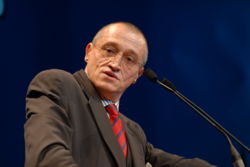
A member of de Villiers, Mouvement pour la France Couteaux is on record as saying that he would like to see France distancing itself from the union.
Poland

Cyprian Gutkowski, a number of the regional assembly of Mazovia, Poland. A supporter of MEP Maciej Giertych, 72, of the League of Polish Families who was censured in the EP for his booklet suggesting the Jews were biologically different.
Finland
 Timo Juhani Soini (born 30 May 1962 Rauma, Finland) is the leader of the True Finns party. Member of the Parliament of Finland. The party has 5 seats in the Finish parliament.
Soini was a member of the Rural Party (Suomen Maaseudun Puolue, SMP), and was Party Secretary General from 1992 to its end in 1995. He joined the True Finns Party (Perussuomalaiset) when it was founded in 1995 and succeeded Raimo Vistbacka as Chairman of the party in 1997.
Soini was his party's candidate in the 2006 Presidential election. He finished fifth out of the eight candidates in the first round, with a vote share of 3.4%. A book about Soini, Maisterisjätkä, was released by Tammi on March 2008.
Soini has been accused of xenophobia, which, as a devoted Catholic, he denies.
Greece

Georgios Georgiou,MEP: Georgiou 72, is a member of the People’s Orthodox Rally.
Georgiou’s Party has recently moved from being anti-semitic to advocating gay rights.
United Kingdom
Lord Alton (David Patrick Paul Alton)

Alton is a former Liberal Party and later Liberal Democrat Member of Parliament (MP) who now sits as cross bench member of the House of Lords. He was made a Life peer as Baron Alton of Liverpool in 1997. David Alton has British and Irish citizenship.
The most respected of Ganley’s recruits, Alton is noted for his opposition to abortion. In 2007 Alton was one of a number of people lodging an appeal against the decision of the Secretary of State for the Home Department refusing their application for deproscription of the Peoples Mojahedin of Iran.
It is claimed that Alton was the author of a chain letter distributed by independent Irish MEP Kathy Sinnott.
IRISH MEP Kathy Sinnott has acknowledged she forwarded a chain letter which called for fasting and nine days of prayer beginning on January 11th, as part of moves to oppose US legislation liberalising access to abortion.
Irish Times 9 Jan. 2009


 Posts
Posts