Showing posts with label Don Di Marino. Show all posts

Sunday, March 22, 2009

Declan Ganley and Iraq from the vaults


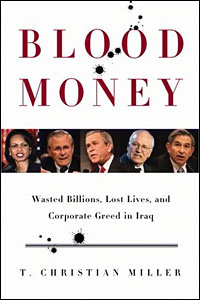
If you have not bought T. Christian Miller's Blood Money you should. It features some information on Declan Ganley in Iraq. It does however give a great deal of info on Jack Shaw who was Ganley and Don Di Marino's pal in Iraq. More on Ganley and Irag from earlier posts.


Here is a contemporary article by Milller originally from the LA Times Published on Wednesday, July 7, 2004

by T. Christian Miller

WASHINGTON — A senior Defense Department official conducted unauthorized investigations of Iraq reconstruction efforts and used their results to push for lucrative contracts for friends and their business clients, according to current and former Pentagon officials and documents.

John A. "Jack" Shaw, deputy undersecretary for international technology security, represented himself as an agent of the Pentagon's inspector general in conducting the investigations, sources said.

In one case, Shaw disguised himself as an employee of Halliburton Co. and gained access to a port in southern Iraq after he was denied entry by the U.S. military, the sources said.

In that investigation, Shaw found problems with operations at the port of Umm al Qasr, Pentagon sources said. In another, he criticized a competition sponsored by the U.S.-led Coalition Provisional Authority to award cellphone licenses in Iraq.

In both cases, Shaw urged government officials to fix the alleged problems by directing multimillion-dollar contracts to companies linked to his friends, without competitive bidding, according to the Pentagon sources and documents. In the case of the port, the clients of a lobbyist friend won a no-bid contract for dredging.

Shaw's actions are the latest to raise concerns that senior Republican officials working in Washington and Iraq have used the rebuilding effort in Iraq to reward associates and political allies. One of Shaw's close friends, the former top U.S. transportation official in Iraq, is under investigation for his role in promoting an Iraqi national airline with a company linked to the Saddam Hussein regime.

The inspector general's office — which investigates waste, fraud and abuse at the Pentagon — has turned over its inquiry into Shaw's actions to the FBI to avoid the appearance of a conflict of interest, the sources said.

The FBI also is looking into allegations, first reported by the Los Angeles Times, that Shaw tried to steer a contract to create an emergency phone network for Iraq's security forces to a company whose board of directors included a friend and one of Shaw's employees.

Shaw, who held top positions in the Reagan and George H.W. Bush administrations, declined to comment for this article. In previous interviews, he has denied any financial links to the companies involved or receiving any promises of future employment or other benefit.

Shaw justified his investigations under a special agreement with the Pentagon inspector general, Joseph E. Schmitz. The August agreement created a temporary office headed by Shaw called the International Armament and Technology Trade Directorate. Its mission was to cooperate with the inspector general on issues related to the transfer of sensitive U.S. technologies or arms to foreign countries.

Shaw frequently cited the agreement in his dealings with reporters and the military, telling them it allowed him to "wear an IG hat" to conduct investigations. In a recent letter to the inspector general, he said the agreement gave him "broad investigatory authority."

That contention is the subject of dispute, however. The agreement states that Shaw "may recommend" that the inspector general initiate audits, evaluations, investigations and inquiries, but it does not appear to give him investigative powers.

"Jack Shaw was never authorized to do any kind of investigation or auditing on his own," said one source close to Schmitz. "The agreement was not for that. He's trying to cram more authority into that agreement than it gives him."

Schmitz canceled the agreement two weeks after Shaw was first accused of tampering with the emergency phone network contract. Schmitz declined to comment, but in his letter canceling the arrangement, he praised Shaw for "outstanding leadership."

Shaw used the agreement to win permission to visit Iraq last fall. In an Oct. 28 letter to Army Gen. John P. Abizaid, head of the U.S. Central Command, Shaw said he wanted to "investigate those who threatened the national security of the United States through the transfer of advanced technologies to Iraq."

Specifically, Shaw said he planned to identify countries that had smuggled contraband weapons into Iraq and catalog existing conventional weapons stockpiles.

Although he did not mention it in the letter, Shaw also was interested in investigating operations at the port of Umm al Qasr.

Last summer, Shaw was visited by Richard E. Powers, a longtime friend and lobbyist. Powers was representing SSA Marine, a Seattle-based port operations company that had won a controversial limited-bid contract in the early days of the war to manage the troubled port.

He also was representing a small business owned by Alaskan natives called Nana Pacific. Under federal regulations, small companies owned by Alaskan Native Americans can bypass the normal process and receive unlimited, no-bid contracts.

Powers suggested there were serious problems with dredging at the port that could be quickly remedied by having a no-bid contract awarded to Nana, which then could subcontract to SSA Marine, sources said.

Powers did not respond to requests for comment. Public lobbying records show that Nana and SSA Marine paid Powers $80,000 last year for his work.

In December, Shaw flew to Kuwait to inspect the port. The military refused to allow him into the facility, however, because of the danger involved, Pentagon sources said.

Shaw and several staffers then went to the port dressed like employees of KBR, the Halliburton subsidiary that has a contract to supply the military with food and other items.

In a KBR hat, Shaw and his staff spent less than an hour at the port, taking pictures and talking with soldiers, current and former Pentagon sources said. The group documented well-known problems there, including the presence of unexploded mines.

A Defense official in Shaw's office acknowledged that they had entered the port despite the military's concerns. He described the disguise as an attempt to conceal Shaw's status, for safety reasons.

He said the military's negative reaction to the proposed visit convinced him that there was serious trouble at the port.

"This Army two-star said, 'We won't let you in the country.' I said, there's something there," said the Defense official, who did not want to be identified. "Everybody had declared victory at the port…. We looked at the port and there were still tremendous problems."

When coalition officials learned that Shaw was at the port, they made a frantic effort to locate him, but didn't reach him until after his return to Kuwait.

"I get this call from [the U.S. military command in Iraq] that said: 'We have an undersecretary of Defense roaming the countryside. We need to locate and secure him,' " recalled a former CPA official. "He's in the country illegally, but we can't arrest him, so we let him finish the tour."

Shaw spent about a week in Iraq, meeting with top U.S. and Iraqi officials. He told several officials that the trip to Umm al Qasr had convinced him that work at the port had to be accelerated. He then suggested that the work could be expedited by awarding the contract to Nana, several former CPA officials said.

"The only time I heard Nana's name was when [Shaw and his team] were in Baghdad," said a former CPA official involved in the ports. "The notion was that this might well be a vehicle where you could in fact get things moving quickly that needed to be done, such as dredging and so forth."

Soon after Shaw's visit, the CPA granted Nana a construction and communications contract worth up to $70 million. Nana then subcontracted $3.5 million in work to SSA Marine, which recently completed the dredging.

Nana also is linked to Shaw's other investigation.

Late last year, Shaw began looking into the award of cellphone licenses in Iraq after receiving complaints from a longtime friend, Don DeMarino, who had worked under Shaw at the Commerce Department.

DeMarino was a director of a consortium called Liberty Mobile, one of the losing bidders in the contest that awarded the cellphone licenses, potentially worth hundreds of millions of dollars, to three other firms.

Relying on information from DeMarino and Liberty Mobile's president, Declan Ganley, Shaw cast doubt on the validity of the awards by leaking to several media outlets information that he said showed corruption in the process, said current and former Pentagon sources. He also provided the evidence he had gathered to the inspector general.

In December, the inspector general's office released a report saying that no basis had been found for Shaw's accusations. The office referred part of the complaint to the British government for further investigation of two British CPA officials involved in the licensing process, according to a copy of the report obtained by The Times.

British authorities exonerated the men. Later, Deputy Defense Secretary Paul D. Wolfowitz wrote to the British ambassador clearing them.

"The British ambassador in the U.S. has received notification that no British citizens are under investigation by the U.S." in the contract matter, a British Embassy spokesman said.

Soon after Liberty Mobile lost the bidding war last fall, Shaw began pushing Nana to win a no-bid contract to build a communications system for the Iraqi police, fire and security forces, according to officials with the now-dissolved CPA and documents obtained by The Times. He then tried to change the language of the contract to allow the creation of a cellphone network, according to interviews and documents.

Nana planned to subcontract the construction of the communications system to a company called Guardian Net. Guardian Net's board of directors was nearly identical to that of Liberty Mobile. It included DeMarino, Ganley and Julian Walker, who works for Shaw as a researcher, according to the documents.

Ganley and DeMarino have acknowledged participating in the attempt to win a cellphone license. Walker could not be reached for comment.

When CPA officials reported their concerns about the Guardian Net plan to Pentagon investigators, Shaw stepped up his investigation of the role of the CPA officials in the licensing process, Pentagon sources said.

Even after the Pentagon canceled the agreement that Shaw had used to justify his probe, he unilaterally continued the investigation, Pentagon sources said.

On May 11, Shaw delivered his report, which concluded that there was "serious, credible evidence of criminal wrongdoing by U.S. government employees pertaining to taking official acts in exchange for bribes."

He acknowledged that the report "directly conflicts" with the December report by the inspector general, which he dismissed as "worthless."

Shaw's report, which The Times has reviewed, claims evidence of a conspiracy to take over Iraq's cellphone service led by Nadhmi Auchi, a British businessman who has been accused of links to Hussein and who was convicted last year in a French court in an unrelated kickback scheme. Auchi maintains his innocence and is appealing.

Auchi, according to the report, paid bribes through a series of surrogates to win the three cellphone licenses and gain control of Iraq's cellular system.

A spokesman for Auchi denied Shaw's claims. He acknowledged that Auchi has an indirect, minor stake in Orascom, one of the cellphone operators. He denied any ownership interest in the other phone companies.

Shaw's report relies mainly on newspaper articles, rumors and secondhand conversations reported by the losing bidders or anonymous sources and "the Arab street," which Shaw calls "a reasonable sounding board for accepted truth."

In the conclusion to his report, Shaw recommends that all the cellphone licenses be canceled and that the contract be awarded to one of the original bidders — as long as the bidder uses a technology known as CDMA, which Shaw describes as superior to other cellular technologies.

Shaw sent his report to the inspector general's office, which turned it over for further investigation to the FBI. An FBI official confirmed that the agency had received the report and had just begun looking into the allegations of bribery.

"While some of the evidence in this report is fragmentary, the dots are connected in convincing and important ways," Shaw said in the report. "Below the deadly serious efforts to restore security and legitimacy to Iraq lies a muted gold rush mentality."


Saturday, February 14, 2009

No Free Lunch:Ganley's Irish Independent hack Bruce Arnold attempts to divert from Libertas' disarray with accusations of smears.

Libertas Lackey Bruce Arnold has claimed that there is a smear campaign against Declan Ganley which seems to involve everyone who has ever spoken out against him or Libertas. Arnold was a guest at the Ganley organised dinner in honour of Czech Eurosceptic President Vaclav Klaus. (Full guest list at bottom of post). This dinner was Ganley's attempt to show himself as a regal and real player and was a deliberate attempt by him in collaboration with a state visitor who came at Irish taxpayers expense to embarrass the Irish government . Ganley stage managed the event to turn the Lisbon No vote into his own personal mandate. However the dinner was seen as a deliberate insult to the Irish people as Klaus was their guest.


Arnold asks questions in his piece about Ganley's eastern activities. He does not answer them. When he next dines with Mr. Ganley could he please find out the truth behind Ganley's Anglo Adriatic Investment Company and publish that? If Declan Ganley answered questions more forthrightly, then the confusion about his past and his current program would be resolved for once and for all. Arnold does not refer to the personal vendetta that Ganley and Libertas are waging against Minister for European Affairs Dick Roche. Their website host two recent attacks on him from Ganley while Arnold's article is yet another attempt at the same. Ganley is still smarting from being caught out over his claim his nationality was listed as British on his company returns due to a mistake "box filling". Roche pointed out on live radio that they were handwritten.


While Arnold presents Ganley as a victim anyone who watched the Primetime show on Ganley may take a different view. Arnold cannot ignore the contradictions between Ganley's statements and those of other people featured. Especially moving was the old pensioner who had lost his savings in Ganley International's Anglo Adriatic Investment Fund.

Read Arnold's defence of his ally below
Declan Ganley is the victim of a shameful smear campaign

Saturday February 14 2009

'Dick Roche is still looking. He has found nothing'

Declan Ganley was the most successful Irish politician of 2008. He won the Lisbon Treaty referendum, throwing the Government and opposition into chaotic confusion. He did this democratically. This irritated the losers, particularly Dick Roche. As Minister for Europe, Roche was significantly at fault for the defeat. He was well-versed in EU Lisbon Treaty intricacies, so this was inexcusable.

The campaign points made by Ganley throughout 2008 have been consistently ignored; instead, personal attacks have been launched. Among actions taken was an unbalanced, ill-researched and, in my view, malicious 'Prime Time' programme. The 'Irish Times' has published exclusively negative stories. There have been 'Village' magazine attacks, the latest of these provoking legal action by Ganley, now partly resolved.

Dick Roche was a significant contributor in 'Village' magazine, quoted as saying: "Declan Ganley is a liar, a self-employed mythologiser, a snake oil salesman".

Two smears have been applied, the first the US Funding Smear, the second an Irish Funding Smear. These have been conflated by the European Parliament's smear, where MEPs have used flimsy allegations and employed dubious procedures. Evidence in favour of Ganley has been ignored, as have his fundamental rights.

Democracy is undermined when public institutions are used in the ways adopted by Irish ministers and European parliamentarians.

RTE's 'Prime Time' programme, on November 27, 2008, was supposedly a profile of Ganley. The Sunday Independent said the programme was "an artful hatchet job, a televised internet conspiracy theory that hoovered up a fair chunk of the licence fee. RTE set out to throw mud, not to shed light, an approach that is the antithesis of public service broadcasting".

This was evident when Miriam O'Callaghan described Ganley as an enigma, asking whether his "incredible life story actually stacked up". She said there were more questions than answers, then delivered further questions,and answered none of them -- 'If [Libertas] isn't a front for spooks, is it a tool for the neo-cons?'; 'Was Ganley linked to Russian organised criminals in his early business dealings?' No answers came.

'Was public money used for this mud-slinging against Mr. Ganley?'; 'Who was behind this?'; 'What are the implications for the future?'

Lucinda Creighton alleged that Ulick McEvaddy and Ganley, whom McEvaddy supports, sought to derail political union in the EU out of self-interest connected with business dealings and their US paymasters, supposedly opposed to EU integration. No evidence has come out supporting this.

Lucinda Creighton criticised McEvaddy's description of the Lisbon Treaty as "unintelligible drivel".

She said: "There is no way this Libertas money is coming from donations." Further smears came from Fine Gael MEP Gay Mitchell. He asked rhetorically: "Are they getting it from the CIA, the UK Independence Party or their friends in the US military?" He offered no evidence. Stories on Libertas's compliance with electoral laws ran in Irish newspapers last September. Ganley replied on RTE radio that he had made a loan of €200,000 to Libertas. He stated that the money had not come from US government sources.

Environment Minister JohnGormley made a statement that Libertas acted lawfully under funding rules. Fine Gael leader Enda Kenny called for changes in electoral law. The papers reported the content of Mr Ganley's radio interview the day before. There were further questions about Libertas funding legality.

Smearing shifted to the European Parliament, where Daniel Cohn-Bendit revealed " ... a link between those who funded the 'No' campaign in Ireland and the Washington Pentagon and the CIA". He took this from Irish newspapers.

Cohn-Bendit claimed Ganley had concluded military procurement contracts with the Pentagon worth about $200m.

He said: "We must continue to keep close tabs on these things, and the facts must be put on the table. We cannot allow Europe to be damaged by people who demand transparency but are not prepared to play by the same rules themselves." This was greeted with applause.

Cohn-Bendit said Dick Roche had "made it his personal responsibility to investigate these matters. I warmly encourage his systematic pursuit of the truth". Dick Roche is still looking. He has found nothing.

The allegation that Libertas accepted CIA funding is a criminal allegation and the parliament's use of press reports for a criminal allegation is disproportionate. Mr Ganley's rights have vanished.

The truth is, Ganley won. The others lost. The Government made a mess of the campaign.

While Cowen and Roche fumbled their way towards defeat, Ganley focused on what was wrong with the European Union. He mounted an unwavering campaign. He led the 'No' vote groups in a detached way, making no alliances, dismissing ideas that were central to other 'No' voters.

The Cowen-led government then made an extraordinary mistake, indicating they would seek to reverse the decision. Brian Cowen advised Gordon Brown to ratify the Lisbon Treaty. This approach, relayed to Europe, was supported by Martin.

'No' vote activity might have declined, with the Government achieving their objectives in a subtle way. Instead we had angry confrontation. Motivation for trying again should have come from Europe, with a reluctant Dublin Government sticking with the democratic choice. Hearts and minds would have changed. Instead, the Dublin Government led the charge, insulting 'No' voters, siding with defeated.

This astonished Europe. The French presidency responded warmly, Nicolas Sarkozy visiting Dublin to seek the second referendum. This move had further negative effects. Sarkozy's new form of EU democracy was what Declan Ganley's Libertas opposed.

There was a campaign against Ganley's political credibility. The allegations to destroy him have not been established. From the start they served a political purpose, to divert responsibility for the Irish 'No' vote into stories about political funding.

What Ganley has said on Europe's democracy is never reported. The December Summit dealt with peripheral matters, ignoring his criticisms. This lack of fairness and balance is reprehensible. We should be ashamed of ourselves.

LEADING OPPONENTS of EU integration, anti-abortion campaigners and prominent figures in the Irish news media featured on the guest list for Tuesday 11 November 2008 dinner in honour of Czech president Vaclav Klaus, hosted by Declan Ganley of Libertas.
The list of those who accepted an invitation to attend was as follows: Mr Declan Ganley; Mr Jens-Peter Bonde; Ms Jens-Peter Bonde Dr Hans-Peter Martin; Ms Caroline Simons; ambassador Tomas Kafka; First Lady Livia Klausova; guest of honour, Czech president Vaclav Klaus; Mr Gary Hunter; Mr Pat Flynn; Mr Robin Matthews; Mrs Frances Matthews; Mr David (Harry) Hewitt; Mrs Frances Hewitt; Mr Kevin O'Connell; Mrs Kevin O'Connell; Mr Philip Lee; Mr Denis Bergin; Mr John Hughes; Mrs Helen Hughes; Mr Darius Sobkow; Mr Christophe Beaudouin; Mr Philippe de Villiers; Mr Mike Feerick; Mr Jiri Weigl; Mr Jiri Brodsky; Ms Margaret Costigan; Mr Bruce Arnold; Mrs Mavis Arnold; Mr Anthony Coughlan; Mrs Muriel Coughlan; Mr Patrick Louis; Mr Constantin Gurdgiev; Ms Jennifer Hord; Mr Frank Fitzgibbon; Mrs Frank Fitzgibbon; Mr Tomas Pojar, Czech deputy minister for foreign affairs; Mr Ladislav Mravec; Mr John Reid; Fr Michael Ross; Mrs Anita Kelly; Mr Gerard Lawless; Mrs Catherine Reid; Mr Chris Coughlan; Mr Colum Coughlan; Mr Michael Ganley; Mrs Bernadette Ganley; Mrs Margaret Roarty; Mr Eamon Dunphy; Ms Jane Goggin; Mr Paul MacDonnell; Ms Catherine McCartney; Mr Damien Fallon; Mrs Fiona Fallon; Mr Alan Kennedy; Ms Marta Myskova (photographer); Mrs Libuse Schmidova; Mr David Cochrane; Mrs Norrie Keane; Mr John Smith; Ms Mary Durkin; Mr Martin Mulroy; Mrs Eilis Mulroy; Ms Claire O'Donoghue; Ms Evonne Corcoran; Mr Francis O'Flaherty; Mr Sean Ascough; Mr Tom Ascough; Mrs Jackie Ascough; Mr Martin Daly; Mrs Barbara Daly; Cllr Martin Ward; Mrs Martin Ward; Mr Sean Ganley; Mr Tommy Keane; Mrs Claire Keane; Mr John McGuirk; Mr Richard Waghorne; Mr Jason O'Toole; Mrs Agnieszka O'Toole; Mr Martin Alioth; Mrs Mary Finnegan; Mr John Lee; Mr Keith O'Grady; Mrs Zuzana Rìcov; Mr Jindrich Foreigt; Mr Radim Ochvat; Ms Kathy Sinnott; Mr David Fieldsend; Mr Jesper Katz; Mr Alan Campbell; Mr James Prior; Mr David Gray; Mr Keith Birch; and Mr Walter Patterson.

Thursday, January 22, 2009

Declan Ganley of Libertas silencing free speech and a free press by issuing spurious threats of legal action?


Ganley says he'll sue!all the time!
where are the actions?

Declan Ganley likes to talk about openness, democracy & transparency – but
does not always accept a central feature of an open democracy – the right to hold an
opinion that differs from Ganley's own.
Declan Ganley frequently threatens
litigation. In this he is travelling the same path as James Goldsmith
another rich Europhobe who used the threat of Court action to silence
opponents.

1. In the last week of November 2008, Ganley's solicitors issued
threats of legal action to Irish politicians, including Joe Costello
of the Irish Labour Party. This follows comments by Costello regarding
Libertas funding. According to the Irish Times "Mr Ganley has
threatened to sue Mr Costello for substantial damages, following Mr
Costello's charge that the Libertas founder has "a subversive foreign
agenda".

2. Ganley also threatened to sue Jim Higgins MEP

3. Ganley has issued several threats to take on journalists incl the
RTE team that produced the Prime Time special

4 Irish Times journalist and long time reporter on Declan Ganley's strange affairs
Colm Keena has been threatened with legal action.


5. In May 1999 he threatened to sue the Irish state on being told that the
the representitives of the Irish government would not continue discussions on
Ganley' s purchase of a fertilizer plant IFI in Co. Wicklow. When told that the
state
was not interested in further discussions on his plans for IFI Ganley
got very pissed off and said siad he would go to the Courts for redress.
Told by a director at IFI, that "…
that the shareholders had jointly decided
to stop
discussions with Grande Portage and that they were reassessing the
options available to them. "[Ganley] replied by saying, 'It was going
to get interesting and this was not good enough.' He said he would
pass on the matter to his solicitors and he was not going to sit back
and let this all happen.' Ganley added 'I will take legal action and
this will end up somewhere in the High Court.' Ganley never sued. See
Fertiliser bomb ignited Ganley's anger, Sunday Tribune 19 January
2009. reproduced below

6. He did commence an action against the Irish state on the mobile phone
license – his bid was the lowest scoring in the contest – the case was
ultimately thrown out.

7. Action has even been threatened against people posting messages on
Politics.ie, a website controlled by one of his associates David Cochrane
an employee of Libertas who owns and runs the site with Ganley
promotion in mind.


Fertiliser bomb ignited
Ganley's anger
Public Affairs
Ken Foxe reports
Sunday Tribune

Wednesday, January 14, 2009

Declan Ganley and Albania. Transparency or just the same old Elites?

Article from an Albanian perspective on Declan Ganley and his Ganley International , Anglo Adriatic Investment Fund. This article alleges collusion between Ganley's AAIF and the Albanian Government and asserts the funds were used as leverage for Bulgarian business Cable net.
Ganley' s business affairs are fascinating if not transparent.

People Korps

Rinascita Balcanica, 14.04.08

"Albanians gambled on the stock exchange."

by
Alketa Alibali


The shares of 45 thousand share holders of the financial concern Anglo Adriatika where "played with" on international stock exchanges by the directors of the foundation. This is according to official sources of the "Ganley Group" who explain that the company succeeded to gather 45 thousand share holders through the Anglo Adriatika foundation in Albania, amassing a capital of about 120 million US dollars in 1997. A declaration by the organism dealing with privatisations of Albanian public property indicates that the Irish group used the issuing of vouchers to place the amount as the company's own funds on international markets. But in reality, they represented 120 millions transferred by 45 thousand Albanians, described as the shares of the "Ganley Group".


The Irish company "Ganley Group" has collected the 1997 120 million dollars in he market for savings, thereby enrolling 45 thousand Albanian shareholders through the Anglo-Adriatika foundation in Albania. The Irish group acquired such securities, as their own property and then sold them on international markets as values representative of the company.


In 1997 "Anglo-Adriatika" deposited securities at the former Bank for Savings in anticipation of the privatisation of strategic companies in Albania. In the same year, the Ganley Group declared that it held 120 million dollars of "Anglo-Adriatika", and deposited, in collaboration with officials of the Bank for Savings, a certificate that guaranteed the ownership of shares, and granted the right to sell them on. We are talking about an amount of around 160 million dollars, at present dollar values, whereas when it was made when the dollar was quoted at 133 lek. The Albanian financial concern which got the first licence to exercise such activities in April 1996, was the Anglo-Adriatic Investment Fund controlled 90% by Ganley Group and 10% Rothschild Emerging Markets.


The manoeuvres with the bond privatization came to light in September 2007, during a trial conducted against him in Ireland, highlighting the "dark" collaboration between the Albanian Government and heads of the "Anglo-Adriatika." The court discovered in fact a kind of collaboration between the "Meksi" government and the head of "Ganley Group, Declan Ganley, who had acted as mediator to finance a number of Irish Members of Parliament to help the Albanian government to avoid the collapse of the financial pyramid schemes. According to Irish media, the same Declan Ganley declared before the courts that he brought Deputy Liam Lawlor to Albania, and while there was paid a fee of 340 thousand U.S. dollars by the Albanian government.


But the interest of the judges falls, especially on an Mr Frank Dunlop (Irish), who is thought to have favoured an Irish company in return for the aid and assistance offered to the Albanian Government. This version has always been denied by the President of Anglo-Adriatika, which denies any involvement with Mr Lawlor, or with the Albanian deputy, who is thought to have favoured the increase in shares of the company "VAT".


Currently the Ganley Group continues its activities in Galway in Ireland, with offices in all countries of Europe excluding Albania, and operates on a wide variety of activities worldwide, such as transport, telecommunications and by controlling interests in Rivada, Broadnet and Cable Bulgaria. But the history of the Ganley Group begins with the experience of Declan Ganley at the age of 21 years in Russia, entering the industrial business through the stock exchange in the iron, and a number of other companies, sold at a later time to the "Soros" foundation.

After gathering money in Albania in 1997 through the Anglo-Adriatika, Ganley buys shares of telecommunications companies in Bulgaria and creates Bulgarian Broadnet, a cable television service within the countries of Eastern Europe, with a total investment of approximately 300 million dollars, with an operation which suggests that it most likely was financed partly by the shares of Anglo-Adriatika, presented as assets of Ganley Group on international stock exchanges.

In 1998 he takes the first steps to create the Albanian stock market, sponsoring a regional meeting in Struga (Macedonia), with the participation of senior officials from the Albanian and Macedonian governments. In the same year, Don de Marino (Executive Director of the Fund) is the leading organizer of the "Strategic Conference in Albania." At the same time, the Canadian company "Grand Portage Resources", with the intermediation of Anglo-Adriatic Found, acquires the exclusive joint exploitation of Lake Delvina, thanks to an agreement with Albpetrol.

Next begins the escalation of Anglo-Adriatika by the activation of the shareholders vouchers in mass privatisation, based on the privatisation law approved by the Albanian Parliament in 1998 and the beginning of twinning activity between the Albanian stock market with the Western stock markets, in accordance with the plans of the Anglo-Adriatic.

In 1999, Declan Ganley brings to Tirana a group of powerful investors from"Hyatt Hotels", whom he promised the backing of the Albanian government. At the same time Anglo-Adriatika brings to Tirana the American telecommunications company "Milicom" to participate in the tender for the sale of AMC.

In survey conducted by the newspaper "Albania", it appears that the prominent representatives of the foundation were Pirro Kushi and Kosta Trebicka, today known as entrepreneurs. Of the two, however, Trebicka is now known to the general Albanian public for his involvement in the scandal of the acquisition of weapons for the Pentagon. Trebicka and Kushi have for a long time in constant contact with the President of Ganley Group, Declan Ganley, and still maintain a regular relationship with the manager of the Anglo-Adriatic fund, Declan Ganley. "Yes, I often had meetings with Declan Ganley and his brother, we speak often - declares Trebicka in the newspaper 'Albania' - "we also speak of the 'Anglo-Adriatic' fund, and I do not agree with some media which have presented it as a business linked to Greek interests".

On the role of Don de Marino, the Albanian newspaper says that in addition to being a board member of one of Declan Ganley's companies, he is also a very powerful businessman, linked to the Bush family and President of the Saudi-American Chamber of Commerce. As shown by the newspaper, Don de Marino was also Executive Director of Anglo-Adriatika, and in 2000 was in Tirana seeking to reactivated the share vouchers and threatening the Albanian government with an international legal action, but without any great results. Finally, it must be noted that de Don Marino and Declan Ganley asked insistently in 1996 that the Tirana stock market be opened, seen as an important to quote at the international level the securities of "Anglo Adriatic." "Yes, I have excellent relations with him - confirmed Trebicka - I do not understand what's wrong on this. Of course, it is true that he is a very influential person, and it is also true that Don Marino also has many friends at the Pentagon."

A mystery remains about the 120 million dollars belonging toAlbanian citizens, even though in 2006 the Parliamentary Commission for Economy and Finance decided to open an deep inquiry into Anglo-Adriatika, questioning even Governor Fullani. It is not known, therefore, whether the "Anglo-Adriatika" or "Ganley Group" have bought property in other countries through the "unlawful use the stock of financial securities of Anglo-Adriatika." Certainly, Albanian citizens' money from a financial harvest at a time when all financial pyramids were about to collapse, was re-invested in industrial activities, more or less speculative, a foreign financial group, with the full complicity of the Government and Institutions.

Alketa Alibali

Article
NB Libertas.eu did have a "facts" page attempting to refute some of the issues raised here but they have taken the page down. Some cedit for this may be claimed by People Korps who used Libertas employee David Cochrane's Politics.ie board to show the lack of credibility.
Subscribe to peoplekorps

Powered by us.groups.yahoo.com